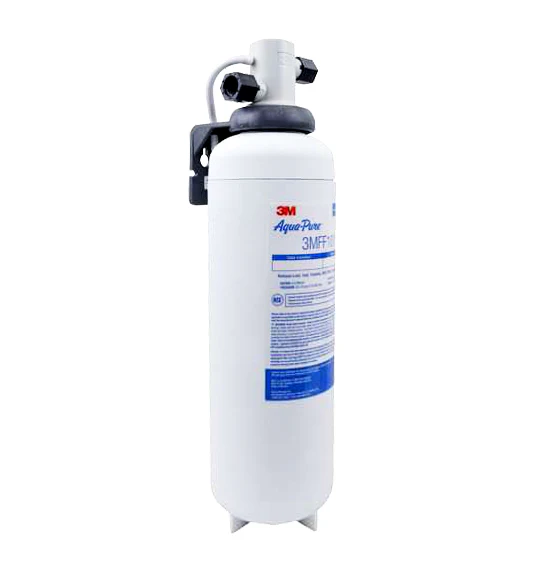
3M FF100 Series
Okay, so this right here is the Cadillac of undersink filters: a full flow filter with a capacity of 6000 gallons, and filters down to 0.2 microns. The NSF says it can reduce particulate, chlorine taste and odor, parasitic protozoan cysts, lead, and select volatile organic compounds (VOCs) such as benzene and p-Dichlorobenzene. (Standards 42 and 53)
But how does it work?
It uses three stages, one right after the other. The first stage blocks the larger particles with a screen.
Then, a membrane accordion blocks particles as small as 0.2 microns. To imagine what that looks like, imagine cutting a bacteria into 5 pieces. Each piece would probably be about 0.2 microns.
Finally, the last stage is a big ol’ block of activated carbon. This stage reduces chlorine, taste, and odor and select VOCs that may be present in the drinking water.
What about changing the filter? How often should I do that?
We could spend hours talking about gallons and average family usage, and all kinds of variables. But, the simplest way to look at it is this: Replace it when the water pressure starts to slow down OR when it’s been more than a year.
You can push it past a year, if you really want to, but once you start getting into the year and a half to two year range, I’d start to get a little skittish about safety.
As far as actually changing it, it’s about as easy as changing a light bulb. Just twist it (lefty loosey) and it’ll automatically shut off the water. Be careful at this point because it’s full of water and a bit heavy.
Then, take your new filter, take off the red cap if it’s still on there, push it back into the head and twist (righty tighty). Listen for the ‘whoosh’ to make sure it’s in there correctly.
Then, run the tap for a few minutes to flush out any dust or little bits. And voila! Filter replaced!
Dimensions:
Width and Depth: 4.5"
Heights:
Just the Cartridge: 14 3/4"
System (Cartridge + Head): 16 1/8"
Total Clearance (so you can change the cartridge): 19 1/8"
Product Information
Product Information
Shipping & Returns
Shipping & Returns
Description
Okay, so this right here is the Cadillac of undersink filters: a full flow filter with a capacity of 6000 gallons, and filters down to 0.2 microns. The NSF says it can reduce particulate, chlorine taste and odor, parasitic protozoan cysts, lead, and select volatile organic compounds (VOCs) such as benzene and p-Dichlorobenzene. (Standards 42 and 53)
But how does it work?
It uses three stages, one right after the other. The first stage blocks the larger particles with a screen.
Then, a membrane accordion blocks particles as small as 0.2 microns. To imagine what that looks like, imagine cutting a bacteria into 5 pieces. Each piece would probably be about 0.2 microns.
Finally, the last stage is a big ol’ block of activated carbon. This stage reduces chlorine, taste, and odor and select VOCs that may be present in the drinking water.
What about changing the filter? How often should I do that?
We could spend hours talking about gallons and average family usage, and all kinds of variables. But, the simplest way to look at it is this: Replace it when the water pressure starts to slow down OR when it’s been more than a year.
You can push it past a year, if you really want to, but once you start getting into the year and a half to two year range, I’d start to get a little skittish about safety.
As far as actually changing it, it’s about as easy as changing a light bulb. Just twist it (lefty loosey) and it’ll automatically shut off the water. Be careful at this point because it’s full of water and a bit heavy.
Then, take your new filter, take off the red cap if it’s still on there, push it back into the head and twist (righty tighty). Listen for the ‘whoosh’ to make sure it’s in there correctly.
Then, run the tap for a few minutes to flush out any dust or little bits. And voila! Filter replaced!
Dimensions:
Width and Depth: 4.5"
Heights:
Just the Cartridge: 14 3/4"
System (Cartridge + Head): 16 1/8"
Total Clearance (so you can change the cartridge): 19 1/8"